Marketing reading list

I was recently invited to a Sunday guest workshop/lecture about startup marketing for DDVE Master’s students. One of the questions I was asked was good books and other resources about marketing. Here’s the list I sent over, with some later additions:

  • Viral Loop by Adam Penenberg gives a good overview of evolution of viral marketing concepts from Tupperware parties to just before the time companies like Zynga took viral concepts onto a completely new level. Apparently every new employee in the Facebook marketing teams gets to read it.
  • Don’t Make Me Think by Steve Krug. If you’re building anything on the web, you’ll want to read this. Perhaps not the latest thinking in UX and web design, but author makes some points that were just as valid 7 years ago than they are now.
  • Influence: The Psychology of Persuasion by Robert Cialdini. Not really a marketing book, rather a book about the applications of psychology into marketing and selling. A useful read nevertheless.
  • The Four Steps to the Epiphany by Steven Gary Blank. Not one for a beach holiday – and I’m speaking from the experience. A bit textbooky, but the good news is that it covers the process of customer development so thoroughly it’ll probably stick with you forever. Must read for tech startup builders/marketers.
  • Inbound Marketing by Brian Halligan and Dharmesh Shah. Dharmesh is the king of inbound marketing but he only shares the very basics in this book. Great if you’re new to content marketing, a little light if you’re intermediate to advanced.
  • Clockwork Pirate (free ebook) by Kelvin Newman. The guy behing The Internet Marketing podcast has put together this short and very practical book on link building.
  • …and don’t forget the classic Positioning by Al Ries and Jack Trout.
  • All these were Amazon affiliate links by the way. If you choose to buy any of these books, I’ll use the proceeds on liquor, women and gambling, so don’t worry, this won’t result in more reading lists.

    When it comes to blogs then there are more good ones than a mortal could ever read. I try to stay on top of Conversation Marketing, SEOMOZ blog and Startup Marketing blog and count on twittersphere to bring me the rest of marketing news and trends.

    Also, I’m a big fan of podcasts because I can use my commute or otherwise “empty” time slots for consuming them. I regularly listen to Internet Marketing podcast which is practical and SEO-focused, and Six Pixels of Separation, which is a collection of interviews with authors and thinkers in the field of communication.

    Any good ones I’ve left out?

    Dilemma: gambling money vs. good causes?

    This week a UK-based link marketing agency emailed me and offered me 170 dollars for posting an ad for a gambling site. I don’t need or want to earn money from this blog, so at first I thought I’d just ignore the email. Then it dawned to me I could use this money for Kiva microloans, or just donate it to charity. But I couldn’t quite make up my mind whether this would be 100% kosher from the ethical point of view as the money is somewhat stained with an addiction that has ruined the lives of many.
    So hereby I turn to you, the four or so readers of this blog. Should I take the cambling companies money and use it for a good cause or tell them to take their money and … use it on cunning campaigns elsewhere?

    Update March 9th

    I’ve gotten some feedback face-to-face, on Facebook and here (cheers, Sepp!). And it seems I may have over-dramatized this offer. There’s little harm in having an online gaming company fund your Kiva account. So, dear /NAME REMOVED March 12th/, consider yourself linked to and thank you for letting me have a nice Kiva budget!

    Update March 12th

    The agency contacted me again and asked for the reference to the gaming company and agency to be removed as the advert that we asked you to place may come across a little negative to your readers. However, the email also said since this money is going to charity, we will still pay you the $175 as agreed. Though this partially motivated by not wanting any negative coverage by the sometimes-so-unpredictable bloggers , it’s still a somewhat kind thing to do. Kudos to the Gaming Company that wants to fund my Kiva account anonymously!

    Update March 21st

    I had removed the link and emailed my contact person in the unnamed Marketing Agency, but heard nothing back for almost a week. After my second somewhat sarcastic email last Friday I finally received 175 dollars on my PayPal account two days ago. Apparently the person making payments had been sick, silly me for starting to doubt their word [insert smileyface here]. I’ve now made my first gambling-funded Kiva loans to a micro-preneur in Mongolia and a farmer in Kyrgyzstan. To conclude:

    • I now feel a tiny bit more respect towards a certain gaming company and a certain marketing agency.
    • My blog has been useful in many ways, this was the first time the benefit had been financial. (Despite the money not going to me). If you like to write and don’t yet have a blog, you’re missing a trick.
    • Two people out there are closer to their funding goals. You too can contribute via Kiva, even without shelling out your own money when you use this link.
    • Marketing is not all bad, it seems.

    I guess all is well that ends well, especially when the events unfold in such interesting manner like they did this time.

    The one Google Plus profile I really hate

    Recently I looked at a Google Plus profile and immediately wanted to punch the owner of this profile to the throat. The problem was, it was my profile. All that’s there is a bunch of more or less promotional messages about various start-ups I am involved with. It all smelled like a guy with a shiny haircut and crap shoes on a trade fair.

    My logic at the time of posting was I’m not really using G+ that much and my friends are not there, so nothing to lose. And if someone takes action after seeing my post, it’s all gravy. There’s some sense in thinking like this but the fact is I have turned into a social media spammer. I have shat into a communally shared backyard, which to be fair I don’t use that much myself, but which is an important picnic spot for some of my online neighbours. Furthermore, as the result of this was near-zero, I had wasted my own time.

    Google Plus is full of such opportunists, as is Twitter and some of it even happens on Facebook among “friends”.

    Work wise I can’t quite ignore Google Plus but this was sobering. Not quite Saul to Paul moment, but I’ll aim to either remain a passive observer (which seems to be the most popular G+ user status anyway) or improve my shit-to-backyard to share-the-love ratio. AJ Kahn sums it up in his comprehensive post about Google Plus SEO.

    Really use Google+. Using it for the express purpose of SEO won’t be successful. Do or do not. There is no try.

    Everything I’ve learned from marketing in 10 years (5 years later)

    In the process of moving this blog from the old rusty diesel engine to the new shiny WordPress engine, old post drafts popped up like dead fish in a pond after an accident involving lots of chemicals. One was titled Everything I’ve learned about marketing in ten years. It didn’t have an ending or a beginning yet, it was just a sketchy list but surprisingly it made a bit of sense. So I dusted it off and edited it to be readable, but didn’t add or remove anything. Here goes:

  • Stand for something. A little bit better than the competition leaves everyone cold. If you have nothing to say, there’s no need to shout about it.*
  • One message at a time.*
  • When conducting market research, ask only whether the message you are sending out has been received as intended, and nothing else. The one thing you definitely shouldn’t ask your customers is “what would you like to have”. *
  • Always put 10% of your budget in risky channels and promotions ie. where they might bomb but, if successful, that generates a healthy ROI.*
  • Work for a boss that wants big change.**
  • Test where the limits that shouldn’t be crossed are, with advertising or whatever you have to play with. ***
  • None of the above tips apply if you just want to sell a bit of goods, and not do something remarkable.

    Footnotes AD 2012:

    * Fully agree to this day, I thank the year 2007 version of myselt for the reminder.
    ** 2012 addition: or be an entrepreneur that wants big change.
    *** Back in 2007 most of my marketing career had been in media or FMCG, where there’s hardly any disruption in the business itself. So it made a lot of sense to push the limits with communications, because this was all there was. With startups, you’re so much closer to disrupting businesses and business models and there’s much less of a need to do scandalous communications.

    Please help me complete the commandments of marketing. What have I missed?

    This blog has a new home

    As you might have already noticed, my blog is now here at purde.net. Also, it now finally runs on WordPress because MT stopped cutting it about 4 or 5 years ago. RSS feed remains the same and includes add-ons like my Flickr feed and the hip quotes I post on Other people’s thoughts. If you don’t like to see my photos (I don’t blame you), you can get the normal feed from the corner of the address bar. I guess that covers the housekeeping stuff. Shoutout to Jens who helped with the move.

    One thing I absolutely love about the blog move is that it brought old post drafts to surface. I just stumbled upon a draft from 2007 called “Everything I’ve learned from marketing in 10 years”. It’s totally worth translating to English and posting here as the first proper new post, to showcase both the wisdom and the naivety I possessed five years ago. Just watch this space.

    Pay a Blogger Day, a lost bet and 945 pushups

    As I’m writing this my hands are a bit aching from making 290 pushups (out of 945) which I said I would do if Pay a Blogger Day minisite doesn’t get one million unique visitors. I lost the bet, the site only got 45 thousand uniques over the first week. A shameful lost bet, but I’m doing these pushups with a victorious grin, because Pay a Blogger Day worked like a charm.

    Some background: my client Flattr provides a simple way to make small donations online, which is really handy for software developers, bloggers, charities, etc. It’s a service Dave McClure would call a vitamin rather than pain killer, in the sense that although it’s a good thing you never feel an acute need for that. There is not a single person in the world that wakes up one morning with a desire to make a small donation to his or her favourite podcaster and types “small donations service” into Google. So how do you find more users to a service like Flattr? One of the ways is to make people think (about the various people that deserve their money). Or so we thought.

    The basic idea for Pay a Blogger Day formed quickly and naturally, almost by itself. The thinking was that if we make more people to pay bloggers at least one day a year, more people would want to do it regularly, and of those, a share would want to use Flattr for that. Grow the pie kind of thing.

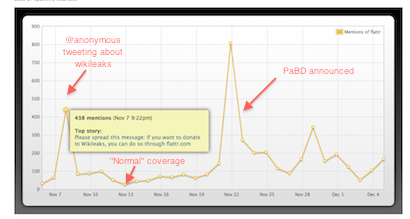
    So we created a minisite, prepared a video, got a few partners aboard and talked to some bloggers and journalists. So on Nov 22th Mashable wrote a piece about Pay a Blogger Day. GigaOm soon followed, as well as Telegraph and more than 50 other blogs around the world. There were lots of great quotes, like:

    While the day is obviously a great marketing ploy by the micropayments website it’s also an easy way to pay fractions on the dollar to your favorite writers.

    See them all on Storify (also embedded to the end of the post), along with many great tweets. Almost all of them mentioned Flattr too, so from purely from coverage point of view it was a (if not raging then at least growling) success.

    topsy%20flattr%20mentions.png
    Flattr needed more than just PR though, so how about other metrics?

    In terms of donations we don’t know how many more donations and purchases we drove that day. Looking at anecdotal evidence it’s probably a number in thousands of euros. One blog reported receiving 70 dollars, another one 150 dollars, Jeremy added a donations button just for a day and collected even more, this beer blog got about 10 dollars, and so on. Number of flattr clicks was 10-20% bigger than on previous Tuesdays, but this figure has been known to fluctuate quite a bit. So, in terms of donations this day bought coffees to some hundreds of bloggers, but (we hope) no one quit their day job just yet.

    In terms of Flattr signups Pay a blogger day added some hundreds of users, which is less than I personally expected but it’s still a decent number.

    So in terms of hard numbers Pay a Blogger was a moderately successful campaign. However, in terms of raising awareness there are now some hundreds of thousands of more people that have given some thought to the need to pay bloggers, and that now know about the existence of Flattr. As the numbers suggest, the vast majority of these people didn’t do much ie. they didn’t pay a blogger and sign up to Flattr immediately, but a seed was planted. Not everyone is an early adopter and most people need to be reached a couple of times with a message before they start taking action. Brian Chesky of AirBnB talked about their PR stunts at LeWeb this week, and he mentioned a similar dynamic.

    Other learnings
    Lots of tweets are no silver bullet. We planned (and built in) three main traffic sources for Payablogger.org site: tongue-in-cheek widgets people could create, tweets, and the video. Banners worked like a charm, Little Gamers alone generated more than 10000 visits to the site when they embedded the widget. But the huge amounts of tweets we got (at peak 4-5 per minute) drove relatively little traffic. According to bit.ly each tweet only got us about 3.1 visitors. So in our case banner/widget real estate on a blog or website paid off better than lots of tweets and RT’s. Video had the least impact, though people really liked it. Should have added some bare skin on kittens…

    Allowing users to interact in simple ways works, be it entering URL, Twitter name or doing the FB connect. Almost 10% of people that came to the payablogger.org site entered a blog URL and generated the forementioned banner.

    Invest time in doing press and blogger outreach. More than 10% of blog posts and articles came from people we reached out to, including the Mashable piece which sparked about a third of coverage. So even if your campaing is interesting for bloggers and viral, it doesn’t spread itself.

    Partners buy you credibility, especially if you’re a relatively small startup. Having Posterous and some other names listed on the site or in an email to a writer from Mashable greatly helped. Also, in our case partners added info about Pay a Blogger Day to their newsletters, which generated much more traffic than their tweets or blog posts.

    All in all a great campaign, with some great learnings. Shout outs to Flattr folks for buying into the idea and getting this somewhat risky campaign out. But I guess that’s what all startups need to do, take some risks and do things that are paid attention to.

    Continue reading

    Written by Comments Off on Pay a Blogger Day, a lost bet and 945 pushups Posted in English, Marketing

    Kõrb, põlev mees ja põder

    Kunagi levis laialt nali tšuktšist, kes proovib Moskvast naasnuna seletada, missugune on loomaaias nähtud elevant. Põtra teate? No kohe üldse ei ole põdra moodi, otsib ta sobivaid sõnu.

    Burning Mani festival on mõnes mõttes väga põdra moodi, sest seda on mitte-põletanule (inglise keeles kutsutakse festivalil vähemalt korra käinud inimest burneriks) väga keeruline kirjeldada. Võibolla annab mingigi pildi ette see, kui kujutada ühekorraga ette katastroof-futuristlikku filmi Mad Max, popkunstnik Jeff Koonsi kogu loomingut, joogalaagrit ning väga raju pidu Ibizal.

    Kui see ei tekitanud mingisugustki muljet, siis äkki aitavad paar fakti. Burning Mani toimumiskoht on Nevada kõrb, kus pole jooksvat vett, kanalisatsiooni, elektrit, internetti ega mobiililevi. Selle eest on seal hulgaliselt liiva ning tugevad tuuled, mis aeg-ajalt liivekeeriseks või -tormiks ühinevad. Festival toimus sel aastal juba 25. korda ning oli sel aastal esmakordselt viimase piletini välja müüdud. Ürituse haripunktis viibis Black Rock Citys, selles vaid nädalaks rajatavas ringikujulises linnas, korraga rohkem kui 50000 inimest. Seda on natuke rohkem kui on elanikke Pärnu linnas.

    Festivali meeleolu kirjeldab hästi tõik, et kohepeal puudub kaubandus. Raha eest saab osta ainult jääd, nii et söök, jook ja kõik muu eluks vajalik peab endal kaasas olema. Samas, eriti hea tahtmise ja väikese rahakotiga saaks selle nädala elatud ka niisama. Asi on selles, et kõige hinnatum valuuta on nähtamatud teistele heameele valmistamise pagunid. Naeratusi ja tänulikkust võid välja teenida kas kingituste tegemise, joogi ja toidu jagamise, muljetavaldava kunstiteose loomise, meelelahutuse pakkumise või mille iganes muuga, mis kellegi festivali paremaks muudab. Kes ehitab festivali jaoks ringisõitva tuldlõõskava kaheksajala, kes korraldab aasta otsa tuluõhtuid, et saaks nädalaks kõrvesse tasuta jooke pakkuva baari avada, kes loob laserkiirte abil maailma suurima kella, kes paneb endale selga kostüümi, mis heal juhul tekitab vaimustunud aplause, halvemal juhul ehmatutuse ja unehäireid, ja nii edasi.

    Üsna lihtne oleks nii-öelda sirutada käsi välja ning olla kõige selle vastuvõtjaks, seda kas praktilistes küsimustes nagu söömine või siis meelelahutuse osas. Playal liikuski ringi ka üsna argise olemisega inimesi, kes niisama teisi vaatasid või neist pilte klõpsisid. Kuitahes häid kaadreid nad ka ei saanud, oli teisel pool läätse viibivatel inimestel festivalist kindlasti palju rohkem rõõmu. Burning Man pakub kõige rohkem nendele, kes tulevad seda kaaslooma, mitte kõrvalt vaatama.

    Ja see tekitab harukordselt nautitavaid loovaid doominoefekte. Üsna levinud festivaliliikuriks on läbi aastate olnud autost või bussist ümbeeehitatud laevad, sest ringisõitev laev näeb kõrbes kohe eriti äge välja. Sellel aastal oli keegi nende jaoks ka saja meetri pikkuse paadisilla ehitanud, ja kalastamise sõpradele lahkelt silla otsa ka õnged välja jätnud. Või siis see inimene, kes tsirkusekarkudel kõndijatele baari ehitas. Muidu baar nagu baar ikka, mõistagi tasuta jookidega, aga baarilett asus umbes kahe meetri kõrgusel, nii et ilma jalapikendusteta oli raske baarmani jutule saada.

    Täiesti omaette artikli võiks kirjutada playale nädalaks püstitatud kunstist, aga seda peaks pigem tegema keegi, kes oskab sinna juurde ka sobivaid erudeeritust väljendavaid omadussõnu valida. Kunsti on seal rohkem, kui jõuaks paari täispäevaga ära vaadata, ning oli selgelt näha, et kunstnike fantaasiat ei piiranud mitte lõuendi või galerii suurus, vaid kilomeetrite viisi kõrbe.

    Nagu ürituse nimi aimata laseb, on üheks festivali oluliselt komponendiks puust mõnekümne meetri kõrguse mehekuju põlema panemine, millest festival kunagi ka välja kasvas. Täna on palju olulisem ja emotsionaalsem sündmus templi, kõikide uskude ja umbsuskude pühakoja, põletamine viimase päeva õhtul. Burning Mani tempel oli hüvastijätmise koht, mis sel aastal kui festivali teemaks oli Rites of passage, tundus eriti olulist kohta omavat. Neli kuud valminud templi seinadele jäeti nädala jooksul tuhandeid hüvastijätkukirju, lubadusi, meenutusi, kahetsusi, fotosid ja mälestusesemeid – et see kõik tuhaks põletada. Näha kedagi templisse lähedase tuhka laotamas, ema ja tütart kallistamas või kirjutamas trepinurgale kirja, mille adressaat seda kunagi ei näe, oli pisarateni liigutav. Ja kuigi Burning Man on eelkõige lihtsalt meelelahutus, võib ta olla pisarateni liigutav meelelahutus, mille pärast nädalaks tuhandete kilomeetrite kaugusele kõrbesse sõitmine ei ole liiga palju küsitud.

    Kirjutatud Ekspressi, vaata kindlasti juurde ka sõber Mareki fotosid.

    Laps kommihüpermarketis ehk esimest korda Edinburgh Fringe’il

    Minu Edinburgh Fringe’i lavadebüüt läks hästi: võitsin võimaluse olla spermadoonoriks ühe briti koomiku õele. Ja seda lauset peaks vist natuke lahti seletama.

    Edinburgh Fringe on maailma suurim kunstifestival, seda vähemasti esinemiskunstide nagu teatri, muusika ja kõige selle osas, mida hõlmab sõna comedy. Nelja nädala jooksul toimub päevas rohkem kui 1300 esinemist paarisajal erineval laval umbes 20000 esineja poolt; lavadeks muutuvad iga aasta augustis ka restoranide-baaride tagatoad, konverentsiruumid ja kooliklassid, aga vahel ka kodud või taksod.

    Juba paar aastat on festivali suurim kategooria just comedy ehk sketšid, stand-up, improviatsioonikomöödia, muusikaline komöödia ja lihtsalt naljad. Heas kommipoes on erinevaid maiustusi nii mõnesaja ringis, nii kui naljasõbra Fringe’ile jõudmise meeleseisundi kirjeldamiseks jääb väljendist “nagu laps kommipoes” selgelt väheks. See on seesama Fringe, kus laiem publik on esimest korda näinud Rowan Atkinsoni, mitmeid Monty Pythoni liikmeid, Stephen Fry’d, Hugh Lauriet ja teisi suuremaid või väiksemaid staare. Edinburghis on sellised esinejad nagu Ricky Cervais läbisegi tuleviku tähtedega, ning ka nendega, kes peale oma Fringe’i debüüti otsustavad jätkata oma baarmani- või pankurikarjääriga. Avastada ja teha on selgelt liiga palju.

    Kuna kõike niikuinii näha ei jõua, siis valikute tegemiseks on kaks head viisi. Esiteks arvustuste lugemine (nt. Chortle’i oma annab hea ülevaate) ja tuttavatelt soovituste küsimine. Teine viis on kõndida mööda tänavat ning siseneda sellesse saali, kuhu kõnniteel seisev sisseviskaja sind parasjagu kutsub.

    Tulles tagasi selle kõige esimese lause juurde, siis sisseviskaja oli meid sel hetkel meelitanud ühele vähem tuntud esinejate tasuta showle, mille käigus olin saattunud lavale ning võitnud kolmeküsimuselise kiirviktoriini. (Mul oli ka väike konkurentdsieelis, nimelt kõik minu viimase küsimuse vastusevariandid olid ühesugused ja valesti vastata ei olnud võimalik). Nii situatsioon kui auhind oli väga fringe’ilik. Kõik on seal lubatud peale elu, reeglite ja iseenda liiga tõsiselt võtmise.
    Kõige parem on planeerimist ja juhuslikkust kombineerida, ostes ette nö. nurgakivideks häid arvustusi ja soovitusi saanud ning peaaegu kindlasti välja müüdavad piletid, ning jättes oma päevakavasse natuke auke, mida jooksu pealt sisustada.

    Nelja päeva jooksul jõudsime vaadata umbes 20 etendust. Kuna comedy ulatub allapoole vööd naljadest kuni intelligentse ja isikliku huumorini, sai lisaks rohkele naermisele läbi elada laia erinevate tunnete spektri. Ainult romantikat jääb Fringe’i puhul väheks, kuigi iseenesest on Edinburgh armas ja vägagi jalutatav linnake. Ühelt poolt on laginal naermises midagi sellist, mis ei mahu minu meelest samasse aegruumi suurema sensuaalsusega. Teisalt kuna huumorialtarile võib heita kõike ja kõiki, siis kahekesi nädalavahetuse fiiling väheneb iga kord, kui keegi teeb nalja oma intiimelu mõne kentsaka seiga üle; ja mida teravam nali, seda raskem on pärast oma kaaslasele sügavalt silma vaadata.

    Tallinnast lendab Edinburghi otselend ning Fringe kestab 28. augustini. Veel jõuad.

    Kirjutatud Ekspressi Kohvrisse
    PS. Järgmine Komeediklubi on 28. septembril, vaata rohkem siit.