Category: English

Pay a Blogger Day, a lost bet and 945 pushups

As I’m writing this my hands are a bit aching from making 290 pushups (out of 945) which I said I would do if Pay a Blogger Day minisite doesn’t get one million unique visitors. I lost the bet, the site only got 45 thousand uniques over the first week. A shameful lost bet, but I’m doing these pushups with a victorious grin, because Pay a Blogger Day worked like a charm.

Some background: my client Flattr provides a simple way to make small donations online, which is really handy for software developers, bloggers, charities, etc. It’s a service Dave McClure would call a vitamin rather than pain killer, in the sense that although it’s a good thing you never feel an acute need for that. There is not a single person in the world that wakes up one morning with a desire to make a small donation to his or her favourite podcaster and types “small donations service” into Google. So how do you find more users to a service like Flattr? One of the ways is to make people think (about the various people that deserve their money). Or so we thought.

The basic idea for Pay a Blogger Day formed quickly and naturally, almost by itself. The thinking was that if we make more people to pay bloggers at least one day a year, more people would want to do it regularly, and of those, a share would want to use Flattr for that. Grow the pie kind of thing.

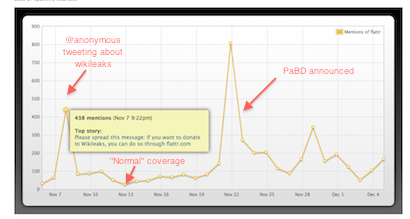
So we created a minisite, prepared a video, got a few partners aboard and talked to some bloggers and journalists. So on Nov 22th Mashable wrote a piece about Pay a Blogger Day. GigaOm soon followed, as well as Telegraph and more than 50 other blogs around the world. There were lots of great quotes, like:

While the day is obviously a great marketing ploy by the micropayments website it’s also an easy way to pay fractions on the dollar to your favorite writers.

See them all on Storify (also embedded to the end of the post), along with many great tweets. Almost all of them mentioned Flattr too, so from purely from coverage point of view it was a (if not raging then at least growling) success.
topsy%20flattr%20mentions.png
Flattr needed more than just PR though, so how about other metrics?

In terms of donations we don’t know how many more donations and purchases we drove that day. Looking at anecdotal evidence it’s probably a number in thousands of euros. One blog reported receiving 70 dollars, another one 150 dollars, Jeremy added a donations button just for a day and collected even more, this beer blog got about 10 dollars, and so on. Number of flattr clicks was 10-20% bigger than on previous Tuesdays, but this figure has been known to fluctuate quite a bit. So, in terms of donations this day bought coffees to some hundreds of bloggers, but (we hope) no one quit their day job just yet.

In terms of Flattr signups Pay a blogger day added some hundreds of users, which is less than I personally expected but it’s still a decent number.

So in terms of hard numbers Pay a Blogger was a moderately successful campaign. However, in terms of raising awareness there are now some hundreds of thousands of more people that have given some thought to the need to pay bloggers, and that now know about the existence of Flattr. As the numbers suggest, the vast majority of these people didn’t do much ie. they didn’t pay a blogger and sign up to Flattr immediately, but a seed was planted. Not everyone is an early adopter and most people need to be reached a couple of times with a message before they start taking action. Brian Chesky of AirBnB talked about their PR stunts at LeWeb this week, and he mentioned a similar dynamic.

Other learnings
Lots of tweets are no silver bullet. We planned (and built in) three main traffic sources for Payablogger.org site: tongue-in-cheek widgets people could create, tweets, and the video. Banners worked like a charm, Little Gamers alone generated more than 10000 visits to the site when they embedded the widget. But the huge amounts of tweets we got (at peak 4-5 per minute) drove relatively little traffic. According to bit.ly each tweet only got us about 3.1 visitors. So in our case banner/widget real estate on a blog or website paid off better than lots of tweets and RT’s. Video had the least impact, though people really liked it. Should have added some bare skin on kittens…

Allowing users to interact in simple ways works, be it entering URL, Twitter name or doing the FB connect. Almost 10% of people that came to the payablogger.org site entered a blog URL and generated the forementioned banner.

Invest time in doing press and blogger outreach. More than 10% of blog posts and articles came from people we reached out to, including the Mashable piece which sparked about a third of coverage. So even if your campaing is interesting for bloggers and viral, it doesn’t spread itself.

Partners buy you credibility, especially if you’re a relatively small startup. Having Posterous and some other names listed on the site or in an email to a writer from Mashable greatly helped. Also, in our case partners added info about Pay a Blogger Day to their newsletters, which generated much more traffic than their tweets or blog posts.

All in all a great campaign, with some great learnings. Shout outs to Flattr folks for buying into the idea and getting this somewhat risky campaign out. But I guess that’s what all startups need to do, take some risks and do things that are paid attention to.

Continue reading

Written by Comments Off on Pay a Blogger Day, a lost bet and 945 pushups Posted in English, Marketing

Pushups, kicks and punches for your mind

You’ll learn a great deal when you go to martial arts training camps. Most of it is technique, some of it is learning about your limits (they’re much further than you think) and almost always there is good old life wisdom involved, too.

I attended a 3-day workshop of a hidden-gem-type martial art called sanjuro a couple of weeks ago. Topics over meals wondered far from dynamic kicks and one dinner I was lucky to sit next to Glenn Delikan, the mastermind behind the martial art. I was sharing some interesting (for me, anyway) choices in my life when Glenn voiced a framework to think about those kinds of things. There are three kinds of things in life, he said. There are things you want, things you ask for and things you need.

Brilliant. And so simple, I guess these things go hand in hand. I’ve developed a habit of looking at my choices in the light of this thought since that conversation, works like wonders.

Then there was the kimura shukokai karate camp some six years ago when sensei Yrjö Pursianen (7 dan) chatted to a bunch of us participants after a tough drill. He said he was recently asked by someone what he had gotten out of his more than 30 years of practicing karate, gallons of sweat, long training sessions and injuries. What’s the payoff after putting in all that effort, the person had wanted to know. To which sensei had replied: I get back everything I put in to karate. And the more I put in, the more I get back.

A great way to look at cost and reward, at journey and the destination, wouldn’t you agree?

Written by Comments Off on Pushups, kicks and punches for your mind Posted in English

A neat viral marketing concept

Went to a TechHub workshop about viral marketing on Thursday and liked it to the extent I wanted to write a quick post about it. Toby Beresford has developed a simple framework for viral marketing which he calls this the petal model.

In a nutshell, there are four kinds of viral loops. First there is direct viral loop (inviting friends)  vs. indirect viral loop (eg. leaderboard that everyone sees). A Farmville example of an active loop is sending someone a tomato plant as a gift, a passive loop is coming to Farmville for the first time and seeing your friends there with nice farms.

The other dimension is positive loop (what do I get if i return every day/week) vs negative loop (what will go wrong if I don’t come back). In farmville positive is getting a crop, and negative is when your plants dry because you haven’t watered them.

Like petals on a flower there is no limit to how many viral loops your product or service may have. No rocket surgery here, but I thought this is a really good framework for hanging your viral loop ideas onto, and seeing whether you had missed any of the loop type for your app or campaign.

I’m looking forward to beta testing Pailz, Toby’s new project, which should have all the differents loops covered. Especially as it’s a business app, not some Facebook game with raison d’être just to kill as many hours as humanly (or robotly?) possible.

The story of Storymarks

Placebook_FB_v1.pngSome postmodern stories have parallel endings, this one has several beginnings.

It could be that the story begun last Sunday. Driving back from a canoeing trip on a flooded river we passed a house by the roadside. A house that looked remarkably average. There’s a story with that house, said my friend. It a house someone won with lottery, probably the only house of that kind in Estonia. Not the most exciting story arguably but it did make that house stand out from hundreds of other houses we passed that day.

It may also be that the story begun a year ago at the first Garage48 event when myself and a hardworking team gave a stab at geo-tagging books and movies. We were underpowered and I guess our vision wasn’t visionary enough, so the project died its painless death after the event. R.I.P. Talepath, you taught the whole team many good lessons.

Another possible beginning is Garage mentor feedback session earlier this week. I pitched my geo-tagging idea again with some improvements, and heard back that it’s still not visionary enough. But it could be if one could geo-tag more than just books and movies. One of the mentors kindly repeated his thoughts over lunch yesterday.

Finally, perhaps Storymarks began last night around 9pm when a group of people walked up to the piece of paper that said something about connecting stories to places and said they liked the idea and wanted to spend the next 48 hours fleshing it out.

So please give a warm welcome to Storymarks, a site where people can connect factoids, news, urban legends, movies and books to real places. We think it’ll make travelling even more interesting than it is today – think learning about an unbelievable story involving fire ladders and a baby rescue just next doors to the hotel you are staying in, or that Pink Floyd once laid 700 iron beds on the beach you’re laying on, just to snap an album cover.

It may start the movement ‘wannabe-travelling’ where you look at your home street with a fresh pair of eyes; eyes filled with moving personal stories, tragic wartime events and the time when someone famous once got arrested nextdoors.

Even the most boring buildings have great stories behind them, some real and some (urban) legends. And famous buildings have hundreds of them. We want to create a place for all these stories, add a story layer to the world, if you will. Please check out Storymarks, become a fan, follow it, give us feedback and add a story for a place you know. If you can’t do all of the above, feel free to skip one 🙂

Learning how to make the best of customer complaints – the hard way

Knickermail-lg.jpgWe’ve had a good number of KnickerMail orders since the launch in December. It’s hardly the next Amazon, but a healthy niche e-commerce site that makes a bit of money and puts smiles on faces of customers around the world.

What I love most about KnickerMail is that it’s taught me more about ecommerce in a couple months that I’ve learned in the last ten years. And one of the biggest lessons has been solving customer complaints.

Before starting KnickerMail we knew what Royal Mail could and couldn’t do in the UK but we weren’t counting on receiving the majority of orders from the US and mainland Europe. Royal Mail’s website led us to believe that the basic delivery service works almost as good as the more expensive options, so that’s what we usually opted for. Big mistake. The basic service works well about seven times out of ten and is hopelessly late rest of the time.

This meant we’ve gotten around ten emails from worried customers. Some have just enquired about the delivery time, others have been less forgiving and have asked for a refund right away.

How do you deal with an unhappy customer?

I wasn’t sure. I had read books, and had spent a good couple of days working at the customer service team back at my Skype days. But I wasn’t sure what to reply when the first less than friendly emails started to arrive.

It didn’t help that at first we weren’t sure what the problem was. Might the delivery be done on the next day? Was this related to one particular area? Are they simply not happy with the purchase and are looking for a delicate way to get their money back?

I decided to use the mantra that Skype employed back in the day – delight the user. This meant offering a full refund straight away if the customer wasn’t happy. I figured it would take the pressure off if people knew that all they needed to do is say the word and they’d have all their money back. And I thought this would open them up to wait a little and, if worse came to worst, accept a new delivery instead of refund (which was better from our perspective – selling with lower margins vs. not selling anything at all).

Naturally, I also wanted to apologise straight away and answer as quickly as humanly possible. Apparently that’s the best thing you can do with an unhappy customer, as I vaguely recalled from some book or article. This sometimes meant typing emails to people in the US at 2AM from my phone in a mildly intoxicated state. The emails went something like this:

Hi name,

Really sorry to hear the recipient hasn’t received the package yet. The delivery time to US is usually around a week but we’ve learned that it can take up to two weeks to for KnickerMail to arrive to the US. I’ve updated the information on our site but I know this doesn’t help you much right now.

If KnickerMail doesn’t arrive in a couple of days please do let me know and I’ll either get you a full refund or send you a new package with the most expensive courier service out there. Really hope this didn’t dampen any plans!

Andrus I KnickerMail


Did it work?

Absolutely. Only one of the ten or so people that had contacted us have asked us for a refund (and immediately gotten it). And with many of the people I’ve developed a friendly email exchange where we’re both looking for ways to get KnickerMail to the lucky recipient. And in the end we’ve received emails like:

Thanks again for this example of good customer service. I’ll be sure to recommend your service to others.

or:

I want to thank you for your customer service and timely response and effort, it says a lot about the people behind the product and I do intend to use it again and spread the word.

I don’t really see the need for a refund, so hope I can come back to you for your offer of a next time free order as soon as you have new models available.

Heartwarming to get emails like this from people you’ve kind of let down.

PS. We’ve added a section with pessimistic delivery times to the site and are using premium postage services now. Perhaps the best way of dealing with a problem is eliminating it in the first place.

How to market your startup at SXSW

sxswi-banner.jpg

SXSW Interactive is a super-sized festival for technology enthusiasts, early adopters, influencers, visionaries and web innovators, or ‘spring break for geeks’ in other words. Among other things it’s an ideal platform for marketing for startups as a large part of their target audience is handily in one place. It is this Austin event where Twitter and Foursquare got serious wind in their sails. The challenge is that there are almost as many startups marketing as there are participants, so a bit of planning is in order. Here are my two cents on how to make the most of SXSW as a marketer after my first gig there.

In a nutshell, SXSW is a collection of panels, random or nor-so-random chats, and entertainment. So there’s your formula for a successful SXSW promotion – panels, parties and people.

Get on a panel

By far the best way to get the word out there is being on a panel. Thousands of people will look at the description and speakers, tens or hundreds will be there in person, you can invite your partners and followers (and hand them out some swag) and can get your community involved before the event – even if they’re not present at SXSW.

The good thing with SXSW is that you have a straightforward way of getting onto the schedule. Any- and everyone can submit their ideas, and the festival’s panel picker has a 30% influence in separating the wheat from the chaff (SXSW staff is 30% and experts decide the rest). This presentation has more background on which kinds of topics are submitted and picked. Hint: apparently the design topics are underserved.

I asked the good people doing the said presentation what were some of the common mistakes that people submitting their ideas make. Their advice was blindingly obvious:
– Specialise your content ie. don’t submit a generic or obviously self-promotional idea.
– Avoid a ‘funny’ headline for the submission, it’s substance over form at this stage.
– Take time to write well and make sure to avoid typos.

Throw a party

Of course, not everyone can get on a panel. Another good cornerstone for your SXSW marketing is throwing a party, or sponsoring one. Larry Chiang is the crowned king of throwing parties for the tech crowd, very much unlike yours truly, so take his words.

groupme%20party%20at%20sxsw.jpg
My educated guess is that parties work best if you’re well-networked and/or you your startup is already burning hot. If you don’t tick either of these boxes, it’s down to the third marketing cornerstone – the hustle.

Try Hustle A or Hustle B

There’s two kinds of hustling. One is when you know exactly who to talk to and make your way to these people via networking, rounds of drinks, clever use of social media and such. The more you prepare the more you’ll get out of SXSW. At the very minimum let everyone know about your SXSW plans and keep an eye on Plancast and Twitter updates of people you’d like to meet. Do that, follow Colette Ballou’s evergreen networking tips and you’ll do fine.

The only thing I would add is: don’t be a human logo. If you wear a colourful branded T-shirt, you kind of stand out but perhaps not in a good way. There’s a trade show at SXSW, you may come across as someone that has escaped from handing out pins in the booth, not the respected co-founder of the next Facebook.

The other kind of hustling is when you just want to get the word out there without spending an arm or a leg of your startup aka guerilla marketing. There’s a ton of it SXSW, some good and some really bad. My advice is straightforward

Keep your promotion related to the product. Example: Squarespace was giving out free meals a block from the convention centre with an enormous banner next to it. The banner didn’t talk much about creating websites, neither did the cardboard flyers they handed out to people in the queue. I know what Squarespace does but I’m sure the company doesn’t have a 100% awareness even with the SXSW crowd. For someone lured in just with the promise of free junk food it’s too easy to forget what the product behind it was.
Simply showing your logo is not enough. GroupedIn had plastered their logo all over Austin but I’m guessing I wasn’t the only one who just couldn’t bother to check out what the company actually does.
Random handing out swag like T-shirts is as effective as always. Not very effective, that is. The real influencers have their swag bags filled already, and only relatively random people will stop.
– A side-note on T-shirts – if you do decide to hand them out, for instance to people coming to hear your panel, then keep in mind it’s not the real America. I made the mistake of trying to be clever and ordering more XL T-shirts to be handed out, only to find out that the crowd is more European sized than the Europeans. Bring lots and lots of M-size shirts.
Stickers and posters get overstickered and overpostered (two new words!). Relying on impromptu poster, flyer and sticker distribution can work as a support whatever else you are doing, but doing this alone won’t get you too far as there is too much noise. Every available space gets more than three layers of posters and stickers on it every day.
No babes handing out swag. A couple of startups tried that on street corners, somehow felt very our of place at a festival about innovation.

There is also a fourth way promote yourself at SXSW, which is to rise at the level of creativity (and budgets) of AOL and Microsoft marketers and become an official sponsor, and/or have a booth at the trade show. I’ll not cover this here, there are much more reputable blogs and books for that.

Additional reading:
Quore: What have been the best and worst promotional investments for startups at SXSW 2011?
How to promote your startup for free at SXSW

Hope this was helpful, and happy to answer any questions regarding promoting at SXSW, just comment below or email.

Flattr at SXSW

I was at SXSW with Flattr, the social micropayments service. My brief, which I received a whole two weeks before the event was to think of ways to leverage Flattr’s panel presence at the festival. I recommended the classic “Educate, leave breadcrumbs, save the world, amuse — and then fix if it doesn’t work” – strategy.

I’m pleased to say this worked rather well.

The focus was on demonstrating the product through amusing. Flattr is sometimes described as the tip jar for the internet. And a couple of months ago the company launched Flattr Offline, which makes any real-live object flattrable. I wanted to put the two things together, so we hired a couple of street artists that did their thing and had Flattr posters instead of hats.

ethan%20flattr.jpg
david%20doyle%20entertainment.jpg
drummer.jpg
The results? Flattr accounts of artists kickstarted, hundreds of visits to their mobile Flattr pages, thousands of south-byers seeing the performers and banners and many more learning about Flattr at SXSW from blog posts and tweets:
Guardian’s Jemima Kiss
t3n.de
alt1040.com
BBC News (scroll to 3.32)
Upvery.com
Tweet example

Screen%20shot%202011-03-29%20at%2001.46.10.pngThe T-shirts we printed were not given out randomly but handed to people that came to listen to the Flattr panel. The shirts featured a QR-code which, if scanned with a smartphone (do not try this at home or at a non-geek conference, at least not for another 1-2 years), took people to mobile-optimised Flattr pages of known charities. Close to the product, yet not over-promotional, wouldn’t you agree?

The breadcrumbs bit ie. plastering stickers with mysterious charity QR codes was something we prepared for but didn’t end up doing too much, after we saw how fast they are covered with a new layer of fellow stickers. But owing mostly to luck, and in small part to the ingenious idea behind the stickers, Guardian used it as the main illustration for their long SXSW piece. A nice cherry on top.

Interviewed by IdeaMensch

Screen%20shot%202011-03-19%20at%2022.07.17.pngIdeaMensch is a community of people with ideas and they’ve interviewed the likes of Seth Godin, Gary Waynerchuk et al. They picked up on KnickerMail and asked a few questions about the site as well as other stuff. So I answered:

Andrus dubs himself serial marketer, being a co-founder or advisor to several startups. Prior to startup life he spent almost five years at Skype in various marketing roles. He co-founded KnickerMail together with promising London-based lingerie designer Kriss Soonik in November last year ‘to balance all this message crafting, product marketing, customer developing, technology stuff’.

What are you working on right now?
We’re testing the wings of KnickerMail to see how far it can fly. It was meant to be a fun small side project, but it broke through the symbolic first €1000 of revenues very quickly and its success means we have to treat it as a fun but very real start-up. There’s day-to-day stuff like answering emails from customers and experimenting with marketing channels. We’re also spending serious time on plans for the future. KnickerMail is not just sending lingerie via post, though that’s what technically happens today. It’s a cheeky way to say hello, and you can have a lot of fun with that proposition.
In addition to that I support Posterbee and Pipedrive with marketing, am a co-founder in Talentag, organise stand-up comedy nights, work on a couple of new startup ideas, write, do a bit of consulting, mentor a team in a youth entrepreneurship program and kind of enjoy the fact I don’t have to worry about planning my free time too much.

3 trends that excite you?
First and foremost I like the way the technology is getting simpler, more accessible and more human almost by day. If you have an idea for a book or a boutique then money or technology are no longer a barrier. You can just grab a couple of free or affordable tools, use free or cheap marketing and distribution channels and crete whatever you wanted to create. Good ideas win, the Snowcalypse T-shirt shop is a recent example I liked.
Not sure if you can call it a trend but I also like the way more companies and people think about sustainability, and act accordingly.

Continue reading

Written by Comments Off on Interviewed by IdeaMensch Posted in English

The village feel of a small market

It’s both a curse and a blessing to do business in a small market like Estonia. This week I experienced the blessing side of things. I was in the middle of one of the busiest three days ever, juggling with organising an ambitious SXSW promotion, rehearsing for my first ever standup comedy compere gig, moving back into my old flat and trying to be a good host for Komeediklubi acts. Oh, and I was scheduled to fly to Tallinn on Tuesday, to London on Thursday and to Austin, TX on Friday. Tricky conditions, wouldn’t you agree.

On Monday I realised I needed 3000 stickers cut out in custom shape for the SXSW thing. I choose to go the ‘bigger fish in smaller pond’ route and googled for sticker companies in Estonian instead of English. Raivo from MR Stuudio was friendly and to-the-point, so I sent the designs his way. All he had was my word, a stranger on the phone’s word, that the invoice would be paid by my UK based client, and he started the machines. This would be unheard of in London or the US, and I speak from experience. And the truly magical moment came when it appeared today that the production is slightly late and Raivo organised the delivery to the departures area of Tallinn airport where I was about to check in. Beautiful orchestration.

Then, Tuesday morning I thought I should print a flag for my comedy night. Angelika from Lipuvabrik said that it can be done if I sent the artwork in an hour, I managed to send it in three, from a train. At noon on the day I realised there was no way for me to have enough time to pick up the flag, so I called Angelika back and asked about courier options. They only had standard overnight delivery which wasn’t good enough. I had six hours to the start of the show, which I explained with some drama, and in the end Angelika offered to swing by the venue herself and drop off the flag. Remember, I was a stranger on the phone who said ‘please’ a lot but who hadn’t even received an invoice at that point, let alone paid it.

So there you go. A company delivering an unpaid order to a stranger that is clearly heading out of the country and another one that goes the extra 2.6 miles to deliver a €25 order after office hours. I’m pretty sure this is only possible in a small market but it’s nevertheless awesome. Estonia, 12 points.